
“Let’s go.”

“We can’t.”

“Why not?”

“We’re waiting for Godot.”

~ Samuel Beckett

Paralysis by Analysis and Other Related Problems

I remember my frustration in high school when we had to study this play.

I mean, the chap doesn’t do anything.

He just waits… And waits… And waits… Who acts like that?

Oops! It happens all the time in business and sales and it is incredibly destructive.

Don’t get me wrong…

  • Analysis is important… Especially after you have results to analyse;
  • Quality affects your reputation… But it’s not only measured in one way;
  • Timing is everything… Not yet is deadly.

There’s a popular business quotation: “You cannot manage what you do not measure.”

It’s true. Even more true is this variant: “You cannot manage if there is nothing to measure.”

Let’s use your introduction as an example of how this works because it’s just as true when you are face-to-face with someone at in-person or virtual networking events, connecting with someone on LinkedIn, or calling someone on the phone. Without a consistent introduction (which may vary depending on your context and audience) you will never really know why people don’t pay attention to you.

It’s not until you have a framework that you use consistently that you can evaluate:

  • What interests people about you and your offer;
  • Whether the appropriate people are interested;
  • How you can increase their interest;
  • What the outcome of that interest is likely to be;

This is especially important to growing businesses who want to take control of their growth.
The Bait Trap

There are a couple of key problems you could face with your introduction and this is just as true whether your introduction is verbal, written, or some kind of lead magnet or attraction tool:

  1. Fishing Trawler Syndrome: Casting a great big net and collecting everything in your path is expensive and demotivating. Just like a trawler, you fish until the net is full, then you come back to shore full of excitement, but when you sift through the catch there are only four or five fish that are worth keeping. If your introduction is designed to appeal to ‘everyone’ you’re simply making your work harder.
  2. Wrong Bait: Investing in an exciting new conversation-opener, lead magnet, tool, or opportunity only to discover that the people you talk to aren’t interested at all can be demoralising. It’s even worse when put all your faith in that one thing and don’t stop to check if it’s working by measuring your results.
  3. Wrong Audience: Talking to people who can’t afford or don’t need your solution is frustrating for anyone. If you don’t have a consistent way of introducing yourself, or set aside time to analyse the outcomes you cannot tell whether you are talking to the right people or not.

Once you have a framework, a plan, and some data, you’ll be in a position to analyse the results. Until then, focus on taking action.

I was working with an in-house sales team last year and once we’d covered this 5 of the 8 team members suddenly realised that they could predict the outcome of any conversation within a few minutes. This was especially powerful at conferences and networking events and suddenly their sales commissions sky-rocketed.

Two of the others were struggling to refine their introductions and wouldn’t commit to consistently testing so they could discover what worked. They were frustrated by the success of their colleagues, but couldn’t find the discipline to stick to the process. The last member of the team was fixated on creating the ‘perfect introduction’. At least, that was what she said. For whatever reason, what did was virtually nothing… And her results reflected her inaction.

Commit or Quit

If you have fishing trawler syndrome, then it’s time to QUIT that practice. You can’t afford the financial or energy-sapping drain on your business this causes. What you lose by focusing on a single market (type of fish), you gain in profitability, simplicity, and results. You can add markets later, once you have a system running in the first one.

If you have a bait problem it’s easy to take it personally, but that’s a dangerous road to go down. Make sure the people you are offering it to really are your ideal clients. If they’re not interested determine whether it is the thing itself, the way it is presented, or the hood you’re using that is the problem. Based on the information, you decide to tweak or QUIT your bait.

It’s easy to misdiagnose an audience problem as a bait problem. At one time I thought that mothers who were returning to the workforce would be a great target audience for my Confident Closing course. They certainly had a problem that the course solved, many of them had an interest as well. But they weren’t interested in investing in a solution. When I QUIT trying to talk to the wrong people about the course, I realised that I had had an audience problem. However, I’ve talked to others who completely rejigged their product in response to an audience problem and then discovered that it didn’t help.

When you COMMIT to the research and reinvention it takes to slice and dice your market, find irresistible bait, and focus on the audience who is looking for your solution you transform your results. In today’s world, it’s more important than ever to manage and measure your lead flow and sales outcomes so you’re not dependent on government regulations or other forces outside your control.

What Can You Control

How you introduce yourself and attract attention is particularly important right now. You can’t control the entire sales process, but you can control how you introduce yourself so that you make yourself especially attractive to your ideal prospects and are either ‘interesting’ or ‘repellant’ to everyone else…

Do it right and your ideal prospects will put up their hand and respond to you so that you don’t have to do the chasing…

That changes everything. It means that you no longer have to wait for Godot – or anyone else. You are in control and you can adjust the flow through your sales pipeline however you wish!

What if…

You used existing data to determine your actions so you could quit guessing and commit to a course of action that got results.

When was the last time you looked closely at the way you introduce yourself in a business context and actually used data to test your opinions?

If you’re like many people, it has been quite some time.

Here are a few questions to ask yourself:

  • If you’re honest with yourself, does your elevator pitch create curiosity and interest… Or just a polite response?
  • Do you actually have a pitch prepared…Or do you just create a response on the fly
  • Can you tell me, with accurate certainty, how many of your introductions lead to appointments, and what the ratio between appointments and sales is?

A powerful elevator pitch is just one of the critical elemental that can transform your ability to attract your ideal clients easily and effortlessly and dramatically accelerate your profitability and business satisfaction.

Stop waiting for the right people to find you…

Set the right bait…

In front of the right people…

And watch the magic unfold.

“Because to take away a man’s freedom of choice, even his freedom to make the wrong choice, is to manipulate him as though he were a puppet and not a person.”

~ Madeline L’Engle

#MeToo isn’t Good for Your Business

Any time you take a look around at ‘what everyone else is doing’ and set your compass by those standards, you are choosing a course that will set you on the fast-track to discount pricing because… you are willfully choosing to look just like everyone else. To be average.

Of course, there’s a place for conformity, too, but in business… it’s dangerous.

I don’t know if you’ve read the Divergent books (or seen the movies), but there are a lot of great business lessons in them. You see, Tris always had that sense that she didn’t quite belong and she had to deliberately choose to fit in for her own survival. Whereas others around her acted instinctively according to the accepted standards, she did so deliberately, always knowing that she had the power to make a different choice.

As a business, you may be tempted to follow that path in the mistaken belief that that is the way to success and survival. My message for you today is that if you want to thrive in a turbulent economy being a copycat is the wrong path to follow.

Unlike Tris, trying to fit in will jeopardise your chance of survival, not contribute to it.

Why You Need to Aim Higher and Ask More… Especially from Yourself

Just to straighten things out before you accuse me of trying to turn everyone into unbalanced workaholics, that is not what I’m advocating.

You see, people are not made to work under constant pressure. Just like a machine, if you constantly subject your mind and body to unreasonable stress and don’t do the required maintenance it will break down. Aiming higher and asking more of yourself includes providing breaks and adventures to open your eyes to new avenues of creativity and growth.

Actually, one of the things you need to ask of yourself is “time out” to regenerate mentally, physically, and emotionally however you most enjoy… And to fill your idea bank with alternative solutions for current problems.

Another powerful tool (especially for the overworked) is meditation and breathing. I was talking about this with someone the other day and he said, “When I feel too busy and hurried to stop, shut my eyes, and breathe deeply for at least 5 minutes, I can just about guarantee I’m going to do something I’ll regret later.”

Just like elite athletes, musicians, and other high performers, if you want to achieve outstanding results, you need an extraordinary commitment to creating the environment and energy you need to do so.

That includes choosing what NOT to do.

Unusual… Eccentric… or Unhinged?

Today, we’re surrounded by unusual personalities who have done great things in many fields. In fact, I would go so far as to say that the outstanding performers in just about every arena have been told they’re nuts… so criticism is probably a good sign!

It’s not just a modern phenomena, either… although it’s probably easier to get away with being exceptionally anything today than it was in the past. Archimedes, one of the greatest mathematicians of the ancient world, was apparently so excited when he finally solved one problem that he jumped out of the bathtub and ran around town stark naked, shouting “Eureka!” Hardly conventional behaviour!

But what about you?

How often do you just look around at what your peers are doing and ignore your own ideas because they’re ‘different’? Zig Ziglar famously said, “If I were going into a new market about which I had no knowledge, I’d look around at what everyone else was doing and do the exact opposite.” He had a point.

However, it takes confidence in yourself, your skills, and your ability to solve problems, to cut a fresh path. The easier way is to follow the ‘blueprint’ someone else has provided unquestioningly without seriously separating principles from tactics. I see a lot of people doing that and it’s one of the business aspects I address in my business development courses.

It’s even more important to develop the analytical and communication skills that enable you to stand up for your ideas, communicate them effectively to your supporters, and execute them rigorously (if not always flawlessly) and confidently.

What Does it Take to Stand Out?

Confidence.

There’s a reason why my sales training and business courses all include “Confident” in the title. It’s the missing ingredient in many sales presentations – whether the speaker is actually selling a product, or is selling an idea, vision, or course of action. The confidence of genuine conviction (and action) is extremely powerful and persuasive… And manufactured confidence doesn’t carry the same power.

Here’s the really exciting part, though!

“You can’t fake confidence, but you can cultivate it.”

Many business owners have a vision of what they want their solution to deliver, but they can’t communicate that vision to others. You cultivate confidence as you learn to communicate the benefits persuasively in terms that others understand… And as you practice doing so. You can also jump start confidence by harnessing the power of your mind using Neuro-Linguistic Programming (NLP) techniques.

Are You Interested in Discovering More?

NLP Mastery Academy meets fortnightly (with a few exceptions over the holidays) to learn, review, and apply NLP techniques in your life. It’s a 12-month online group certification program that explores how these techniques can be used in relationships, personal growth, career and work settings, parenting, and much, much more. Go HERE to learn more. 

Confident Closing and Confident Conversion are our flagship programs for designing and communicating a unique business that stands out from your competitors. These fast-paced, yet thorough programs target the roots of any uncertainty you may have about your business solutions, address them, and help you design a confident and profitable business. Go HERE to learn more. 

“The future belongs to those who prepare for it today.”

~ Malcolm X

The Uncertainty Test

A lot of business coaches are promoting the litmus test of your business’s functional systems as the ability to take a 30-day vacation without checking in, and discover that sales and delivery have increased in your absence. It’s a vital concept… even if you know that your business won’t pass the test it gives you certainty and a goal.

There’s a similar test that I developed for the sales teams I coach to assess their preparedness for changes in the market that I call “The Uncertainty Test”. You may not like the information the test gives you, but it provides a baseline against which you can measure your progress toward sales resiliency that I predict will be crucial in the next few months.

What Would Happen to Your Sales if...

This has been a challenging year for most businesses and it has highlighted those which have robust and resilient sales systems and those which don’t.

Here are some of the important questions for you that will reveal the strength of your sales system:

  • What proportion of your sales come from long-term nurture vs. cold contacts
  • Do you have systematic nurture processes?
  • Do you have systematic outreach systems?
  • If a key member of your sales team left, would it dramatically reduce sales?
  • Do you have a system for developing your team members?

There are several more revealing questions that I use when I’m working with a business or sales team to build or strengthen their sales resilience, but by the time I’ve asked these 5 questions the person I’m talking to is often seriously concerned… And rightly so!

In a booming economy, which we’ve all been enjoying for the past eight or nine years resilient sales systems didn’t matter much. Over the coming months (or possibly years), that will change. There will still be abundant opportunity, but it will flow towards those who are prepared to do the work and learn the skills that others reject.

Three Parts of a Successful Sales System

Building a successful sales system is relatively simple, but it does take hard work and an investment of time and energy. Often, when I’m consulting with clients they’ll say, “I’m so glad that you are managing this strategic process, Chandell. I don’t think we would have stuck with it if you hadn’t been in charge but it’s transforming our results.”

There are three important parts that you need to build:

  1. Expectations: what actions and attitudes do you expect from your team (and that includes any one who is outward-facing). These will included calls, research, nurture, surprise follow-up etc.
  2. Processes and Systems: you should have processes and systems for every aspect of your sales and service including client follow-up because it’s all part of the next sale. You will probably find ways to strengthen them over time, but these documented systems should be a baseline that is rigidly followed.
  3. Training and Evaluation: even your sales stars need to keep their mindset and practices sharp. If they really are expert, ask them to help with your training program design and delivery so they learn new skills.

Systems are the Key to Resilience

Over the past few months I’ve noticed that sales superstars who don’t have strong supporting systems are struggling! Offices are closed, phones are unattended, and gatekeepers have more resources at their fingertips to keep unexpected callers out than ever before.

On the other hand, teams who have robust systems in place have a long list of existing customers to follow up, new prospects to connect with, and they are closing sales steadily. I’m not certain that the market will be this strong in another six months, but I am confident that these sales people will continue to attract a steady flow of deals.

One of the key distinctive is their organised system for following up enquiries. I was talking to someone yesterday whose Business Insurance had lapsed because the Insurer had ‘FORGOTTEN’ to send through the renewal notice and process the auto-payment! I thought that was extraordinary, but one of the other participants in the conversation pointed out that their accountant, lawyer, and stationery supplier had similarly dropped the ball (and were being replaced).

My point: a lot of people are using Covid-19 as an excuse for ‘business flakiness’. If you refuse to go down that path and stick to your systems and quality standards you will stand out like the Eiffel Tower as a landmark of innovation and quality.

Confident Conversion: 90 days to More Cash, More Clients, More Impact

The open sessions of Confident Conversion run 3-4 times per year and are suitable for small business owners or sales managers who want the process of choreographing every aspect of their sales and marketing to be facilitated and who also want an outside eye to help them build the business systems they need for stability and growth.

I also provide various levels of in-house sales training for teams which can take the burden of designing your sales systems and overseeing your sales team off your shoulders and sets you free to focus on the core aspects of your business.

“Every system is perfectly designed to get the results it gets.”

~ Donald Berwick

Why You Have the Sales Results You Do

Read that quotation again… slowly.

You may not like the message, but the truth is that the results you are getting are directly related to the sales system you are implementing.

In my NLP Master Practitioner Certification courses, I teach a powerful tool known as strategy elicitation. I introduce this by talking about the strategies / habits / systems people implement in daily life without recognising them. Almost everyone has a particular way of doing things ranging from the way you dry yourself after bathing, or get into bed, to the way you design complex electrical systems or plan a trip into space.

Whether you recognise it or not, you have a sales system. The question you need to ask is: “Does my sales system deliver the results I want?”

What to Do If You Don’t Like Those Results

Some of my clients, especially corporate sales managers who delegate their team development to me, respond to the question with, “You’ve got to be kidding! Of course not!” or words to that effect.

Other clients are more nuanced, “Not always” or “There are some gaps.” Or even: “I’m getting good results – better than my competitors – but I know I can do more!”

That’s why they’re talking to me… Their existing sales system isn’t delivering what they really want.

When we dig deeper it’s obvious that either their system is ‘random sales acts’ or they have some aspects of their system that are either sub-optimal or destructive.

Once you are aware that your system is letting you down to some degree, you will see things you can change. Try this exercise:

1. Document your existing processes for:

  • Identifying prospects
  • Piquing their interest
  • Making contact
  • Nurturing the sale
  • Closing the sale
  • On-boarding clients
  • Seeking referrals and recommendations
  • Following up lost opportunities
  • Seeking the next sale

2. Analyse these processes and find the gaps;
3. Fill the gaps.

You’ll be surprised at how effectively following this process to the letter transforms your results and shifts them closer to the results you want. You may also be shocked by what you learn about yourself and your team.

This is not a process for the faint-hearted or those who do not like facing unpleasant realities. It is a process for those who want to accelerate both the value and the volume of their sales.

Is Your Sales System Future-Proof?

If there’s one thing this pandemic has taught sales teams, it’s that you need to build systems for both nurturing existing prospects and finding new ones. It has also exposed massive holes in many businesses’ sales systems.

When the economy was riding high, sales and leads flowed almost effortlessly – as tensions have risen, the atmosphere has changed… And so have the stakes.

If your sales pipeline is overly dependent either on existing business or new leads and you don’t have an effective system that balances the two extremes (and many individual sales people do not) then you are at the mercy of the economy and other outside factors.

Confident Conversion: 90 days to More Cash, More Clients, More Impact

This is my flagship program that helps you build the sales systems you need to close sales and fill your pipeline both now and in the future.

There are two facets of this: a small group program for individual business owners or small teams to attend where we work to master the principles and gather the tools required to create effective systems for each area of your sales process. The end result is a sales system that works for you and delivers the outcomes you are looking for.

Alternatively, I offer an in-house version for sales teams where the focus is specifically on analysing and refining your existing sales systems and building cohesive sales teams that deliver extraordinary results.

“As sure as the spring will follow the winter, prosperity and economic growth will follow recession.”

~ Bo Bennett

When Money Flows Up Hill...

Since recovering from the GFC, world economies were on a steady upward curve. By early 2020, unemployment had hit record lows in most of the western world and it was pretty much a job seeker’s dream.

Venture Capital along with both personal or business credit were readily available and small businesses of many kinds were able to establish themselves and build respectable incomes with little or no marketing and very little risk.

That all changed with the global pandemic.

First it was hospitality and travel, then retail, workplaces, schools and almost everything else was either closed or forced online. Suddenly, many businesses were forced to reconsider their economic viability and re-evaluate their strategy, pricing, product offerings and (especially) their marketing and sales strategies.

Just like most other areas of life, a challenging economy is uncomfortable because it asks us to change with no certainty of success. That’s why it’s important to remember that these things go in cycles… and beyond the short term stress are exciting opportunities even if you can’t yet see them.

Responding to Challenge and Change

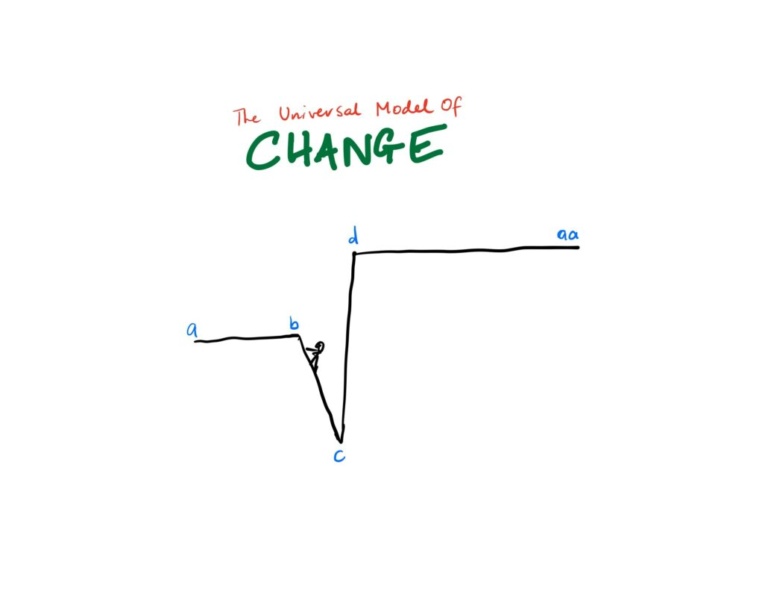
Our response to economic contraction is very similar to any other form of change – except that we often have very little choice about whether to face it or not. Understanding what is happening and how to respond can speed the (usually) painful process of loss, acceptance, and renewal.

If you look at the following diagram you will see that once we fall into the chasm, we often have to make several attempts before we can climb out on the other side breathless, bruised, strengthened, and with a sense of justified pride.

Some of your peers are still standing fearfully on the edge of the cliff, miserable yet unwilling to jump and trust themselves to overcome the challenge, others were pushed off the cliff and now dangle helplessly with no idea what to do next.

You, however, had the courage and initiative to make your way out on the other side and your horizons are wider than ever before. While you look around and start to make your way forward you call back encouragement and advice to the others and give them a vision to strive for and even pointing them to the handholds on the wall of the chasm.

Universal Model Of Change 1030x796

The Universal Model of change

What Does it Take to Set Yourself up for Success in Any Economy

There are three essential areas that you need to consider (and revisit regularly) if you want to look at your life with any lasting sense of satisfaction:

  1. The kind of person you are and want to become;
  2. The things you want to have; and
  3. The achievements you want to attain and the legacy you want to leave behind.

Your specific answers to these will differ depending on your personal goals and values, but there are a few universal success markers including:

  • Specific goals and dreams in all three areas of your life;
  • Willingness to do the work it will take to achieve these goals;
  • Openness to change and growth in order to learn new skills and do new things;
  • Awareness of your fixed principles and boundaries and a willingness to enforce them even if they seem to stand in the way of your goals;
  • Accurate thinking about each situation and the barriers and opportunities it presents;
  • Consistent readiness to find people and organisations who need your skills, services, and products and to promote yourself to them;
  • Systems for every aspect of your business;
  • Confidence in your ability to figure things out.

If you consistently act in accordance with these markers, then you will be set up to succeed no matter what is going on around you.

The Magic of Selling Without Resistance in Any Economy

When the economy is expanding it is relatively easy to sell. When confidence is shaky and the economy is contracting it is essential to have systems for every aspect of your business sales and customer service areas so that you can attract and nurture a steady stream of qualified prospects.

Building and strengthening these systems is the focus of the Confident Conversion: 90 days to More Cash, More Clients, More Impact which is both a public and an in-house training course. The course takes place online and is a combination of personal exercises, recorded prestudy sessions, and weekly live interactive discussions which wrestle with both the theory and application taught.

If you are struggling to fill your pipeline or realise that qualified prospects are escaping through the cracks in your business then this program may be just what you need either for yourself, or for your sales team.

Visit https://bit.ly/CC-90days to learn more.

“Don’t find customers for your products, find products for your customers.”

~ Seth Godin

The Key to Sales is Not Building a Better Mousetrap, but Presenting a Bigger Mouse

Lest us start by summarising the baseline assumptions on which effective long term sales careers are based:

  • Your goal is not ‘a sale today at any cost’ but to enter into a potential long term relationship that serves both the business and the customer;
  • You believe that the product or service you are selling has value to the right customer;
  • It is not your responsibility to decide whether the prospect can afford to buy, but to present the argument for doing so;

That said, in a booming economy making sales is relatively easy whereas a tight economy demands more imagination, vision, and skill… but also present more opportunity as well as other businesses recognise their own need to work smarter.

When a business owner or buyer is staring disaster in the face they are willing to spend almost any amount of money on an effective solution. You may assume that the person you are talking to is acutely aware of the problems they are facing and don’t need to be reminded, but hurrying through the process of painting the picture of the problem they are facing and its implications will slow down (or derail) the sale.

Determining Need

A master salesperson knows better than to try and sell ice to Eskimos. Selling a prospective customer a solution that won’t really address their urgent problems but will absorb resources that ought to be invested elsewhere is bad practice.

Amateurs (and the truly desperate) show up at a business with a product and do their best to sell that item even when they realise that it’s not meeting a pressing need. Of course, it’s the buyers decision in the end, but if you can see that your solution is not the most effective answer, then you’ll win trust and respect by pointing that out.

How do you determine your prospect’s need?

By asking appropriate questions that probe their motivations and also address associated problems that your prospect may not realise are linked to their most visible need.

Motivating Hunger

My book Confident Closing: Sales secrets that grew a business by 400% in six months and how they can work for you! was originally titled “Feeding Salt to Horses”. The premise behind that title was that while you can lead a horse to water, but not make it drink, if you feed him salt he will drink willingly.

As a sales person you face a similar problem: you can’t make a prospect buy, but if you mix emotional triggers in with your reasons and keep the vision of their ‘giant mouse’ front and centre they will buy willingly. Not only will they buy willingly, they’ll also feel a sense of relief as they sign the contract.

Creating Urgency

Have you ever talked to a prospect and truly known that they have a pressing need for your product or service – but then seen them dither about actually saying “Yes”.

I used to see this before I refined my tools for setting up the sale properly. It’s one of the most depressing feelings that has nothing to do with wanting to close the sale and everything to do with wanting my prospects to get the results they desire and need. If you see that your prospect has a genuine need for your product, then it’s your responsibility to create that level of urgency by identifying the negative consequences of not taking immediate action.

Disarming Resistance

It is so much easier to make decisions when you are:

  • Acutely aware of your current pain – and the potential danger you face if you don’t address the problem;
  • Emotionally attracted to an alternative future where the problem is solved and the pain has vanished;
  • Logically satisfied that this is an excellent solution provided by a trustworthy partner;
  • Impressed by the dangers of doing nothing and letting the problem slide; and
  • Faced with an urgent deadline.

At this point you have three choices:

  1. Live with the problem;
  2. Find an alternative solution and evaluate it;
  3. Take the solution you’ve been offered.

However, IF you have built your sales presentation and customer experience carefully, THEN you will already have created trust and respect in your prospect to such an extent that they really only have a single option: to place their trust in your solution and take action.

Discover The Magic of Selling Without Resistance in Any Economy

My live webinar The Magic of Selling Without Resistance in Any Economy demonstrates the principles of setting up this kind of sale. It’s especially important to understand this process when you are facing an uncertain economy.

Visit: https://bit.ly/sales-magic to learn more and register for the next session.

“The greatest discovery of our generation is that human beings can alter their lives by altering their attitudes of mind. As you think, so shall you be.”

~ William James

Are You REALLY Getting Closer to the Life of Your Dreams?

Time is one of the most powerful creative forces… And one of the most powerful destructive forces. It all depends how you use it.

I could dive deep into the philosophy of growth and decay… But I want to focus on the change you can control so I’ll just say it briefly:

“Every day, you are either moving closer to your dreams or further away. It all depends on the direction in which you are heading. Time can increase the effect of your choice, but you control the direction.”

If you are letting the days slide by without taking deliberate actions – both large and small – to move in the direction you choose then time is not your friend. You know it’s true. You can see it reflected in your:

  • Fitness
  • Weight
  • Education
  • Career or Business
  • Income
  • Wealth
  • House (maintenance and cleanliness)…

You get the idea. If you just let any of these areas go, they usually decline.

The same is true when it comes to building the life of your dreams: it won’t happen without discipline and direction.

Do You Even Know What You Want?

I was talking to a friend the other day about this. Ellie is a successful VP who is earning a great salary, has lots of perks, plenty of room to move up the ladder, a partner who adores her…

BUT when she looks at her life she says to herself, “Is this all there is?”

I asked her what she really wanted and she shrugged and said, “I don’t know. I just know that what I have isn’t enough. You’re probably going to say that I ought to be grateful for having so much and stop complaining… Or write in a gratitude journal or something, Chandell. Please don’t.”

Now that’s a problem!

We’ll come back to Ellie later, but first I want to tell you about Seth. Seth had truly made himself a success. He was the first person in his family to go to university (his father was in and out of prison while he grew up) and he completed his Law degree with high honours. He quickly rose up in his top tier law firm  and he was on the fast track to partnership (a long-term goal of his).

One day he looked around at all he had made for himself: career, relationship, wealth, opportunity, hobbies, respect… And said, “Is this all there is?”

And… one of Seth’s hobbies is hiking. Not just anywhere, but hiking in the mountains where the distant view is always more alluring than the near view.

Seth applied that understanding to set a next goal for himself – not an ultimate goal, but a next goal. He could have said to himself, “I’ve arrived and it’s not all it cracked up to be.” But he didn’t. Instead he took control of his future and the attitudes of his mind.

You Don’t Need to Stay Where You Are!

Wherever you are today and however you feel about that, you don’t need to spend the rest of your life in that place (and I’m using ‘place’ to cover mental, physical, emotional, and spiritual options). You can change and you really don’t need anyone to help you (although a mentor or coach is often a tremendous benefit.

You don’t even need to relocate physically to create momentum and direction in your life. You just need to make that mental switch from a ‘victim’ (with a long list of reasons why), to a ‘victor’ with a short list of things to do and an even shorter list of attitudes to cultivate!

It’s NOT (Just) About Gratitude!

Don’t get me wrong – I’m not against gratitude journals and I think about things I’m grateful for every day and usually write them down. Gratitude won’t help you reach for the stars, though. It’s more likely to keep you earthbound unless you are careful because energy flows where attention goes and if you focus too much on being grateful for what you have, you won’t take the next step.

As Ellie and I continued our conversation she realised that she simply wasn’t all that interested in the next step on the corporate ladder. It wasn’t that she couldn’t do it, it was just that the higher she climbed the less she was involved in the parts of her work she loved.

By the time we finished that conversation she knew what she wanted… And she had a plan to get it… And her enthusiasm and vigour were back in full force.

Externally, nothing changed for Ellie. The change in her attitude has already started to bear fruit.

What About You?

Ellie went through a process called a H.O.W.T.O. Session with me. It’s a 90-minute paid session that brings clarity and helps you focus on what you really want so that you can make the decisions you need to make. In that short time, she was able to articulate and recognise what was really bothering her and do something about it.

If that sound like something you need you can book a session using the button below.

Book Your H.O.W.T.O Session

“Think and Grow Rich by Napoleon Hill is one of the most influential books of the twentieth century. Hill inspired millions of people to step out of the misery or constraint of their existing circumstances and create a future full of unimaginable success, yet at one point he had to sell his typewriter to pay his bills and was rescued by a friend. Why?”

~ Chandell Labbozzetta

It’s Not What You Know, It’s What You Do!

I work with many business owners and sales people who have invested heavily in their education and personal development and who have a deep knowledge of their subject, yet who are not seeing the results they anticipated. In fact, that’s why most of them come to me… they realise that they need accountability and coaching so that they can effectively implement the theory they already know.

One of the things that makes working with people so endlessly fascinating is our different strengths and preferences. I love ideas… and the thing that I love most about them is the possibilities they present for testing in real life.

When I first discovered the power of Neuro-Linguistic Programming (NLP) I was fascinated by the theory because of the possibilities of its application in everyday life outside the training room. My response was to practice each technique in every possible situation and to master them all. It wasn’t until I went to my NLP Master Practitioner Certification that I realised how many people who had learned these same techniques had tucked them aside in the ‘knowledge’ part of their brain rather than using them.

The problem with this approach is that your unused knowledge is as effective as ignorance in creating desirable outcomes – that is to say, if you have knowledge but don’t apply it, you might just as well have conserved the time, energy, and money you spent acquiring it.

The Positive Power of Ideas

Ideas are the lifeblood of your personal growth and success. Just as you need to have blood constantly pumping through your body oxygenating and detoxifying your cells, you need a steady flow of ideas to oxygenate and detoxify your business and career so that you remain engaged and flexible.

There’s an old saying: “If your output exceeds your intake then your upkeep will be your downfall,” that applies to many areas of life. It’s certainly true when it comes to the flow of ideas into your professional life. I’m a big fan of developing habits and routines to take the pressure off your willpower but you also need to mix in some new ideas to keep things fresh.

It’s important for every professional to keep learning and growing and to tap into ideas outside your own specialty because that will make you even more effective.

The Persistent Power of Implementation

If ideas are the lifeblood of health and growth, comprehensive implementation and action are the secret of success. Napoleon Hill was a very gifted man whose teaching has revolutionised many lives and who taught the importance of acting as well as thinking. At one stage he was not only highly respected, but also extremely wealthy… Then he lost everything and was rescued from destitution by once of his own students. In an interview later in life he made the following comment, “I defined 17 principles of success and taught others the principle of saving, but I forgot to apply it rigorously myself. In the end omitting to practice just one of these principles cost me everything.”

I’ve worked with business owners who were doing many things right, yet not seeing the success they anticipated. It turned out that the one or two minor things they ignored were their downfall. When they implemented just one or two missing elements consistently everything changed.

If you’ve ever been tempted to say, “I know that already!” when you talked to someone about your problems in life or business, then you’re in good company… It’s what the majority of average people say (and how they act).

BUT… I’d like to challenge you: Are you doing everything you know? Most people aren’t. Successful people are those who recognise that they need help with implementation and find a coach or mentor who will ask the difficult questions and provide the impetus to implement consistently, persistently, and effectively not just in the areas they are naturally drawn to, but across every area of business and life.

Confident Conversion: 90 days to More Cash, More Clients, More Impact

Specially designed for business owners and sales professionals who want to increase their professional standing and impact as well as their income and profitability this course covers the essential foundations that you need to implement effectively and provides accountability and useful tools so you can achieve this easily and effortlessly.

“The root cause of all our problems is our unconscious mind, and the beliefs and behaviours that we store there.  The real problem here is that they are unconscious so it’s very hard to pinpoint them and change them.”

~ Chandell Labbozzetta

The Root Cause of Your Discontent

“I’ve been passed over again!” Samantha’s voice was shaking with anger and frustration. “It doesn’t matter how good my results are, this *** idiot won’t let me move ahead… she’s just like my last manager!”

Samantha is an effervescent extrovert – she is so bubbly that she scares some people. As a high-performing sales professional, this is great because it doesn’t matter how many rejections she gets, she’s always ready to get up and go again. However, she scares off some prospects and her managers sometimes mistake her enthusiasm for naivety and that was holding back her career. This was the fourth time she had been passed over by a manager because of her vivacity and charm and she was desperate for a solution.

During our coaching sessions she quickly realised that while she was genuinely effervescent, she amped it up unconsciously because, as a child she had always been praised for that characteristic. Once she became aware of that, it didn’t take long before she learned how to read and respond to other people better and find more effective ways of communicating with them appropriately.

Because she was truly interested in finding solutions to people’s problems, she quickly learned how to read her prospects better over the phone or in person and to tone down her effervescence when needed and close more sales. Incidentally, that was the last time she was passed over for a promotion.

The Resourcefulness Within You

“You don’t know what you don’t know,” and until you can see a problem it’s very difficult to find effective solutions.

Samantha honestly never realised that her bubbly personality was a learned response to praise.  She didn’t change her personality as much as allow the other side which had always been hidden to shine through. Using some Neuro-Linguistic Programming (NLP) skills for building rapport and strengthening relationships she learned to read other people better and find ways of making them comfortable.

She was excited about the fact that she was able to close nearly twice the number of sales, but she was far more excited by the fact that she was able to build a closer relationship with both her sister and her own son – both of whom were introverts. They’d always got on fairly well, but now they were actually enjoying being together.

Each of us has a unique personality and gifts and we naturally lean more towards people who are similar to ourselves. That’s fine, but it can also be limiting… especially in a business context… UNLESS we deliberately cultivate the skills we need to communicate and work effectively with people who are quite different to us and have their own special contribution to make.

If you find yourself encountering similar situations repeatedly, it’s important to define what is creating them. Often, you have unconscious habits and thought patterns that are triggering other people’s reactions… habits and thought patterns that you have the power to change once you are aware of them. If left untended, these become roadblocks to progress and satisfaction.

Changing Direction and Creating Momentum

I firmly believe that each of us have all the resources we need to make a success of both our business and our personal lives – it’s just that sometimes we get caught up in ways of thinking and behaving that mess us up over and over again.

In a way, we hate to hear this because we like to think that our problems are unique and that’s why we can’t move past them, but if you think about it differently, this reality is quite comforting: – If others have found a tool that helps them change, then I can too.  I don’t need to stay ‘stuck’ in my problem!

The root cause of all our problems lies in our unconscious mind, and the beliefs and behaviours that we store there.  Since they are unconscious, it’s very hard to pinpoint and change them.  When I attended my first Neuro-Linguistic Programming (NLP) training I’d been seeing a psychologist to help with depression for months and going over the same pile of misery every week.  Yet, just 7 short days of training completely transformed my outlook, and I’ve seen the same thing happen over and over again in others.

The key is that while Neuro-Linguistic Programming (NLP) doesn’t teach that your past isn’t important, it does teach that you are not bound by your past and it delivers the tools you need to release the chains that are holding you to your old ways.  It is almost like magic!

Getting Unstuck

For Samantha, the key was our H.O.W.T.O. Session and some subsequent Time Line Therapy® work which showed her the root cause of her behaviour and then set her free to develop the flexibility of communication she needed to move forward. Other people have found similar freedom by discovering the unconscious beliefs and behaviours that keep them trapped in a business cycle of feast and famine, or in a life of poverty, a career or relationship that is stifling their dreams or some kind of addiction or co-dependency. However, while awareness is foundational for transformation, freeing yourself from the emotional traps you set for yourself and accessing the inner resources you need to move forward are also crucial.

If you’d like help with this book a H.O.W.T.O. Session now. You’ll be amazed at how different you feel when you free yourself from the baggage you’ve been unconsciously accumulating for years!

Book Your H.O.W.T.O. Session

“In most Sales Teams there is a predominance of either hunters or farmers. This usually reflects the preference of the Sales Manager and is one cause of poor sales results.”

~ Chandell Labbozzetta

What Do Hunters and Farmers Have to Do With Sales Anyway?

There are two primary types of sales people:

Hunters:

As the term suggests, these people love to talk to new prospects and close sales. They are fantastic at conjuring sales almost out of thin air. Metaphorically speaking, they’re the ‘find and kill’ sales people. They are happy to cold call total strangers, move quickly into a compelling sales pitch, and often walk away with a sale or definite appointment. However, they’re not so good at nurturing relationships over time and turning following up prospects who are not ready to buy.

Farmers:

In contrast to the hunters, farmer-type sales people prefer to talk to people who have expressed interest. They often stretch out the sales cycle and their sales results may be lower. Their approach to sales is more ‘tend and harvest’. Farmer-types find cold calling repellant and, not surprisingly, they rarely get around to doing it. On the other hand, they are endlessly patient and persevering when it comes to following up prospects, staying in touch until they are ready to buy.

However, the exciting thing is that anyone can learn to be a hybrid by studying the opposite mode of sales and you can also build a power team that incorporates both styles.

What Difference Does it Make to my Business?

Both hunters and farmers can be stellar sales people who accelerate your business’s profitability and growth. In fact, high-performing sales teams need a balance of the two types for best results. However, teams frequently lean toward one type or the other because sales managers usually prefer to hire people with the same sales style as themselves.

Here’s the problem: some qualified prospects are ready to buy and make decisions quickly, others are not yet ready to buy either because the timing isn’t right, or because they like to make decisions slowly. Both types of buyers are qualified, but their timelines are different.

If you put a farmer-type sales person in front of prepared and decisive buyers, they may get frustrated while waiting for the contract to appear and give up. If you put a hunter-type in front of a buyer who needs time to think things over, the buyer may feel pressured and simply tune out.

Swap out your sales people and match them with the buyer-types and your outcomes will be quite different.

Do You Know Whether Your Sales Team is Made up of Hunters or Farmers?

Identifying the sales style of your current sales team members is an important first step in transforming your results. The second step is helping each person to grow their sales skills and awareness.

I’ve noticed that some sales people hold the ‘my way is the highway’ attitude. Their thinking goes as follows: “because in the past I have delivered stellar sales using my approach and outperformed other team members this is the best way of selling our product.”

The problem is, this attitude works until it doesn’t…

  • A shift in the economy;
  • A change in personnel (in your company, or your clients’);
  • Developments in technology;

…Or any other transformation can put a damper on sales.

In NLP we say that the person with the most flexibility controls the system. The application of this principle to sales would say:

The person with the most flexible sales repertoire controls business growth and the short-term future of the company.

The exciting thing about this is that sales strategies, and the communication and rapport strategies that underly them can be learned and developed IF your team members are willing to grow.

Knowledge is Power

Understanding the characteristic sales styles of people on your sales team is crucial for growth and prosperity. As a sales manager, knowing your own preferences is also important so that you can balance out your natural prejudices when you hire new people.

You also need to recognise whether your key people are open to developing new skills in the opposite area or, at least, appreciating their own weaknesses. It’s fine to have specialist hunters and farmers as long as they’re prepared to say, “This prospect would be better suited to your sales style than mine.” This way, your business can reap the benefits of both approaches and close more sales.

In-House Sales Training & Assessment

Would you like some expert help evaluating and empowering your sales team so that you can improve results, increase morale, and extend the skills of every member of your team?

Sometimes an objective and skilled outsider can see potential, problems, and solutions and provide a perspective that no one inside the organisation can match.

If you’re interested, email [email protected] to ask about our In-House Sales Training & Assessment program and we’ll send your our questionnaire and schedule a call.

Logo

Share This

Select your desired option below to share a direct link to this page.
Your friends or family will thank you later.